


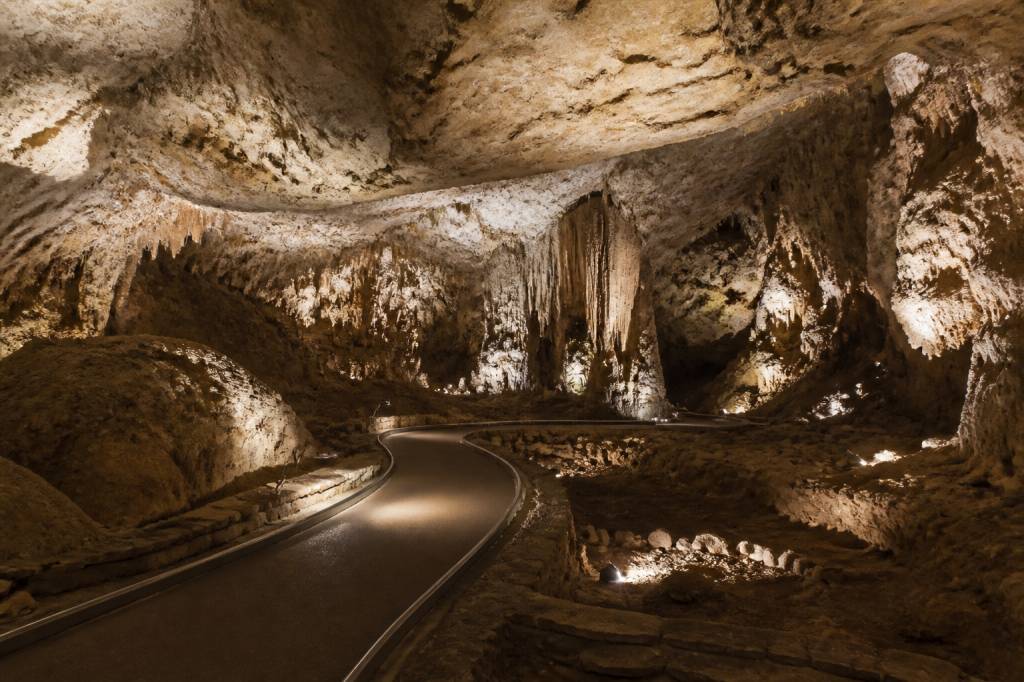
If you spend enough time in the Southwest, you start to realize that the most memorable landscapes are not always the ones sitting out in the open. Some of the region’s best geology is hidden underground, and Carlsbad Caverns is a perfect example. Located in southeastern New Mexico, this national park combines dramatic cave formations, a fascinating natural history, and a few surprises that catch first-time visitors off guard.
If you are planning a road trip through the American Southwest, Carlsbad Caverns deserves a serious look. It is not just “a cave.” It is a massive limestone system with a remarkable story, a unique ecosystem, and one of the most iconic evening wildlife events in the national park system. Below are ten facts that help explain why this place is so much more than a dark hole in the ground.
The cave system is far bigger than most people expect
Carlsbad Caverns is often introduced as one cave, but that description undersells the scale. The park contains a vast cave system with more than 100 known caves, and the best-known section, Carlsbad Cavern, is only one part of the larger underground network. The mapped passages stretch for miles, and exploration is still ongoing in some areas.
That scale matters because it changes how you experience the park. Visitors typically walk into a carefully managed portion of the cave, but they are standing inside an enormous geologic system shaped over millions of years. The visible rooms and passages are only a small window into what is actually there. As a former ranger would likely tell you, what you see is impressive; what you do not see is even bigger.
The cave formed from ancient reef limestone
One of the most interesting parts of the Carlsbad story is that the caves began in an ancient reef. Long before this area was desert, it sat beneath a shallow sea called the Permian Sea. Marine organisms built up a massive reef, and when the sea disappeared, the reef rock remained.
Over time, sulfuric acid and groundwater helped dissolve the limestone and create the caverns. This is a different process from the more familiar carbonic-acid cave formation found in many places. In practical terms, that means the cave owes its shape to a combination of chemistry, water, and geologic time working together in a very patient way. Nature does not rush, even when it is building something enormous.
It is famous for formations with unusual names and forms
Once inside the cave, you quickly understand why so many visitors become obsessed with cave formations. Carlsbad Caverns is packed with stalactites, stalagmites, columns, draperies, soda straws, and flowstone. Some formations are delicate and needle-thin, while others look like frozen curtains or stone waterfalls.
The park’s names for these features are not just decorative. They help visitors recognize how the formations grew and what conditions were present. For example:
- Stalactites hang from the ceiling and form from mineral-rich water dripping downward.
- Stalagmites rise from the cave floor where those drips land.
- Columns form when the two eventually meet.
- Soda straws are thin hollow tubes that show early-stage cave growth.
If you have only seen cave photos before, the real thing can be surprisingly textured. The lighting, shadows, and scale turn the chamber walls into something that feels closer to a cathedral than a tunnel.
The Big Room is one of the largest cave chambers in North America
The Big Room is the park’s signature feature, and for good reason. It is enormous. At roughly 8.2 acres in area, it is one of the largest cave chambers in North America. A paved trail circles the room, making it accessible to most visitors without specialized caving equipment.
Walking the Big Room is a good reminder that “cave” does not automatically mean “tight.” In places, the ceiling rises far above you, and the scale can be difficult to judge until you see tiny people or trail markers in the distance. It is one of those rare environments where you may actually underestimate the size of the room simply because it is too large for your brain to process at once.
If you are short on time, the Big Room is the best return on investment in the park. It gives you an immediate sense of the cave’s grandeur without requiring a full underground expedition.
The bat flight is one of the park’s most memorable wildlife events
Every evening in warmer months, thousands of Brazilian free-tailed bats emerge from the cave at dusk. This is one of the park’s best-known experiences, and it is genuinely worth planning around. Visitors gather at the amphitheater to watch the bats spiral out of the entrance in search of insects.
The event is popular, so a little planning helps. Arrive early, bring water, and expect the timing to vary with weather and sunset conditions. Rangers often give a short talk before the bats emerge, which is useful if you want to understand what you are seeing rather than just standing there waiting for the first dark streaks in the sky.
A practical note: this is not a guaranteed show on every night of the season. Bat behavior depends on temperature, rain, and internal cave conditions. Still, when it happens, it is one of those experiences that sticks with you long after the trip is over.
The cave stays a steady temperature year-round
One of the most visitor-friendly facts about Carlsbad Caverns is that the underground temperature is relatively stable. Inside the cave, it stays around 56°F, or about 13°C, throughout the year. That makes the cave a relief from summer heat, but it also means you should dress for the environment rather than the season outside.
It is easy to make the mistake of assuming a desert park is hot everywhere. Above ground, yes, the Southwest sun can be relentless. Underground, though, the cave is cool enough that a light jacket or long-sleeved layer is a smart idea. I have seen plenty of visitors enter in warm-weather clothes and emerge wishing they had thought ahead. The cave never cares what the parking lot feels like.
The park offers both easy walks and serious adventure caving
Carlsbad Caverns is approachable for casual visitors, but it also has a more technical side. The main cave route is self-guided and paved in key sections, which makes it accessible for many travelers. At the same time, the park also offers ranger-guided and permit-based cave tours that involve crawling, climbing, and navigating undeveloped passages.
This range is one of the park’s strengths. You do not have to be an experienced spelunker to appreciate the underground world, but if you are looking for a more strenuous and hands-on caving experience, the park can provide that too. Just be honest about your comfort level. Underground adventure is fun; underground panic is not.
Before choosing a tour, consider:
- Your fitness level and mobility
- Your comfort with enclosed spaces
- Whether you are okay with dirt, crawling, and occasional awkward body positioning
- How much advance planning is required for permits or reservations
The cave has a remarkable history of exploration
Like many major cave systems, Carlsbad Caverns was known to Indigenous peoples long before modern scientific exploration. Later, in the late 19th and early 20th centuries, explorers, ranchers, and local residents began investigating the cave more systematically. One of the most important early figures was Jim White, whose persistence and curiosity helped bring attention to the cavern.
White is often credited with major contributions to the cave’s early publicity, including helping transform it from a local curiosity into a nationally recognized natural wonder. That kind of history matters because it reminds us that parks are not just created by laws and maps. They are also shaped by the people who notice them, advocate for them, and preserve them before they are lost to neglect or exploitation.
The park sits in a surprisingly harsh desert landscape above ground
Do not let the underground fame fool you. The land above Carlsbad Caverns is rugged, dry, and very much part of the experience. The park lies in the Chihuahuan Desert region, which means hot summers, limited shade, and dramatic changes in weather.
This contrast between harsh surface conditions and the cool interior cave is part of what makes the park so memorable. One minute you are looking at sun-bleached desert vegetation and rocky hills; the next you are descending into a dark limestone world full of moisture, mineral deposits, and bat colonies. It is a sharp reminder that landscapes can be layered in ways we rarely notice from a highway pullout.
If you are combining Carlsbad with other Southwest destinations, it pairs well with other geology-focused stops. The park rewards travelers who enjoy the “how did this form?” question as much as the “wow, that looks incredible” reaction.
The visitor experience is designed to protect the cave, not just show it
Carlsbad Caverns is a place where conservation directly shapes the visitor experience. That is not a marketing slogan; it is a necessity. Cave environments are sensitive to changes in temperature, humidity, light, and contamination. Even something as simple as bringing outside dirt, lint, or biological material into the cave can matter more than people realize.
For that reason, the park uses trails, lighting, controlled access, and visitor guidelines to minimize impact. These measures may seem restrictive if you are used to more open-air sightseeing, but they are essential. Caves are among the easiest natural features to damage and the hardest to restore. Once a formation is broken, it does not grow back on a human timescale. That is one reason the park management is so deliberate.
As a visitor, the best mindset is simple: enjoy the cave, but do not treat it like a theme park. Stay on the trail, avoid touching formations, and respect the guidance from park staff.
Sunset, silence, and scale make this park more memorable than you might expect
Carlsbad Caverns is often described in terms of geology, and rightly so. But the park’s atmosphere is part of what makes it special. There is a sense of quiet anticipation as you descend into the cave. There is the cool air, the echo of footsteps, and the steady progression deeper underground. Then there is the return to daylight, where the desert feels almost absurdly bright after the cave.
That transition is one of the park’s subtle strengths. It is not only about seeing a landmark. It is about moving through two very different worlds in a single visit. If you time your day well, you can experience the cave in the afternoon and the bat flight at dusk, which makes for one of the most satisfying wildlife-and-geology combinations in the national park system.
If you are building an itinerary through the Southwest, Carlsbad Caverns is the kind of place that adds depth to the trip in every sense. It is geologically significant, visually striking, and practical to visit with a little preparation. And unlike many famous natural attractions, it rewards both the casual traveler and the detail-oriented one.
For anyone who appreciates landscapes with a story, this park delivers. The rock is ancient, the biology is active, and the scale is hard to forget. Whether you come for the formations, the bats, or simply the novelty of walking through a world hidden beneath the desert, Carlsbad Caverns earns its reputation the honest way: by being extraordinary.